
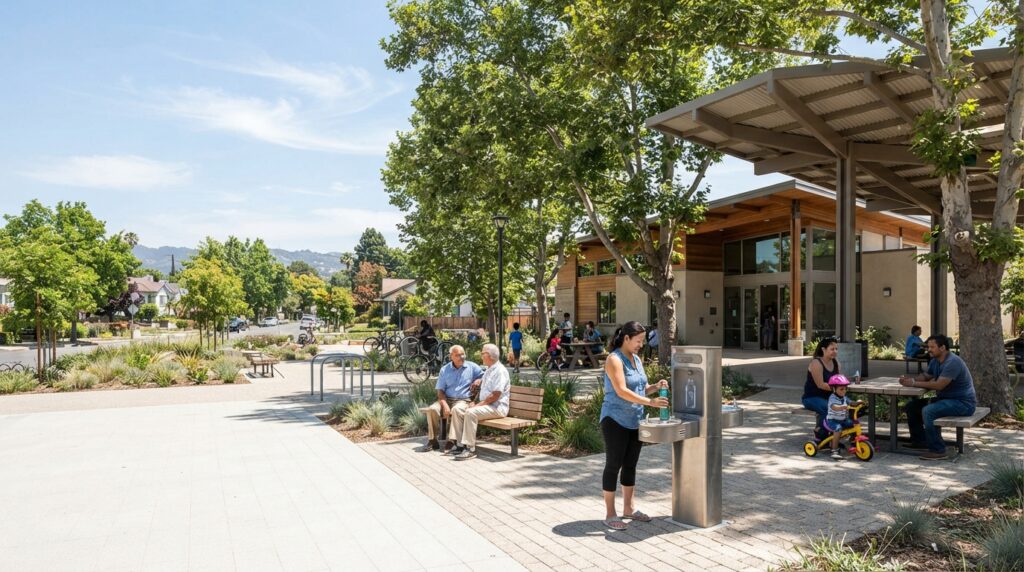
Extreme heat is a community challenge, not only a weather forecast. It can affect outdoor workers, older adults, young children, people with chronic health conditions, renters in hot homes, and neighborhoods with limited shade or cooling. When temperatures rise, the places where people live, travel, learn, and gather can make a real difference to health and safety.
California’s Extreme Heat and Community Resilience Program Round 2 offers a timely opportunity to turn local priorities into infrastructure. The Governor’s Office of Land Use and Climate Innovation has made $27.5 million available for projects protecting communities most vulnerable to extreme heat. Full applications are due October 13, 2026, at 2:00 p.m. Pacific Time. The program is for teams that can combine local authority, community knowledge, and delivery capacity.
Why local heat resilience matters now
Heat risk is shaped by more than the daily high temperature. A neighborhood may have fewer trees, more paved surfaces, limited cooling, or long distances to essential services. Language, mobility, financial, and health barriers can also make it harder to respond. Effective projects begin with local conditions rather than assuming one solution works everywhere.
California’s 2024 Climate Adaptation Strategy identifies stronger protections for climate-vulnerable communities and improved public health and safety as statewide priorities. This program puts those aims into action through locally designed heat infrastructure. It is an opportunity for public entities, community organizations, higher education institutions, California Native American Tribes, and coalitions to build around local needs.
What Round 2 funding can support
Round 2 has two project types. The right track depends on whether a community is still testing an approach or is ready to implement a feasible infrastructure project. Both address extreme heat but serve different stages of readiness.
Early Infrastructure Projects
Early Infrastructure Projects support heat-related infrastructure planning and a demonstration project that tests a proposed approach. Awards range from $750,000 to $1.2 million. This track suits communities that need to refine a solution through planning, design, partnerships, and a practical demonstration.
A team may need to determine how a cooling and shade project should be located, operated, and accessed before expansion. The value of an early project is a community-centered approach that can be evaluated and improved.
Advanced Infrastructure Projects
Advanced Infrastructure Projects fund the implementation of heat-related infrastructure identified through prior planning and determined to be feasible. Awards range from $3 million to $4.5 million. This track is for teams with a developed concept, credible implementation approach, and the partnerships needed to operate the work.
The state’s Round 2 resource page includes final guidelines, application forms, project-type checklists, an applicant preparation guide, and partnership guidance. These documents should guide project design and budget decisions. Informal summaries do not establish eligibility.
Who can apply and how teams work
Every proposal requires a Lead Applicant and at least one Co-Applicant. Eligible Lead Applicants and Co-Applicants include local and regional public entities, community-based organizations, public higher academic institutions, California Native American Tribes, and coalitions. Contributors, supporters, and contractors may join the team but do not replace the required co-applicant structure.
Heat resilience needs technical and community capacity. A public agency may bring infrastructure authority and operations. A community-based organization may bring trusted relationships, local insight, and outreach. A college, Tribe, or coalition may contribute specialized expertise, stewardship, or regional coordination.
Partnerships should be built around delivery
Strong partnerships should clarify leadership, infrastructure management, resident involvement, and long-term operations. When a community-based organization serves as a co-applicant, it must maintain a staffed operational office within 100 miles of the project site. Teams should confirm their structure in the Final Guidelines and Partnership Guide before submission.
There is no required match. If a project needs resources beyond the grant, the team must explain the likely funding timeline in its budget and work plan. Eligible 501(c)(3) nonprofits may qualify for advance payments up to 25 percent of an award, although advance pay is not guaranteed.
Equity and community design are central
Round 2 directs at least 40 percent of funding to projects that provide meaningful and direct benefits to Disadvantaged Communities or Vulnerable Populations. At least 10 percent of that amount must support Severely Disadvantaged Communities. These priorities make local engagement and design essential.
Applicants can strengthen a proposal by describing the heat burden, who shaped the project, and how people will use it. Consider practical access. Can residents reach it without a car? Will information be available in relevant languages? Does the operating plan account for people with disabilities, outdoor workers, and families with young children?
The same community-centered thinking supports other local health efforts. Our article on technology and community health initiatives explores how partnerships and local data can help address service gaps. Heat-resilience infrastructure should similarly be designed with communities rather than simply placed in them.
How to prepare before October 13
The application process includes an important timing condition. The Full Application Form is available only to teams that completed a Pre-Application Interest Form through Submittable. The state lists the two interest-form windows as closed. Organizations that did not complete that step should contact program staff promptly to understand the current options, rather than assuming they can enter the full-application process.
- Confirm that the team completed the required Pre-Application Interest Form and can access the Full Application Form.
- Choose the Early or Advanced Infrastructure track based on actual project readiness.
- Review the Final Guidelines, application checklist, work-plan requirements, and scoring information.
- Document the heat challenge, community engagement, expected benefits, and access considerations.
- Define the Lead Applicant and Co-Applicant roles, including operations and long-term responsibility.
- Build a realistic budget and explain any additional funding required for completion.
- Submit the full application through Submittable by October 13, 2026, at 2:00 p.m. Pacific Time.
This article is an informational overview, not grant or legal advice. The official program materials and live Submittable application are the source of record. Awards are expected in January 2027, with a performance period of 30 to 48 months.
Building healthier places for hotter days
Heat resilience complements California’s wider climate work. Sustainable homes and neighborhoods can reduce exposure through thoughtful design, shading, and efficient systems, as discussed in our article on sustainable housing trends in California. Yet community infrastructure is equally important because many heat protections must be shared, visible, and accessible beyond a single home.
The Extreme Heat and Community Resilience Program gives eligible teams a chance to connect infrastructure with health, equity, and everyday community life. Strong proposals will be specific about a local heat challenge, realistic about operations, and accountable to residents. For communities prepared to act, the October 13 deadline is a chance to advance practical solutions for hotter days ahead.