
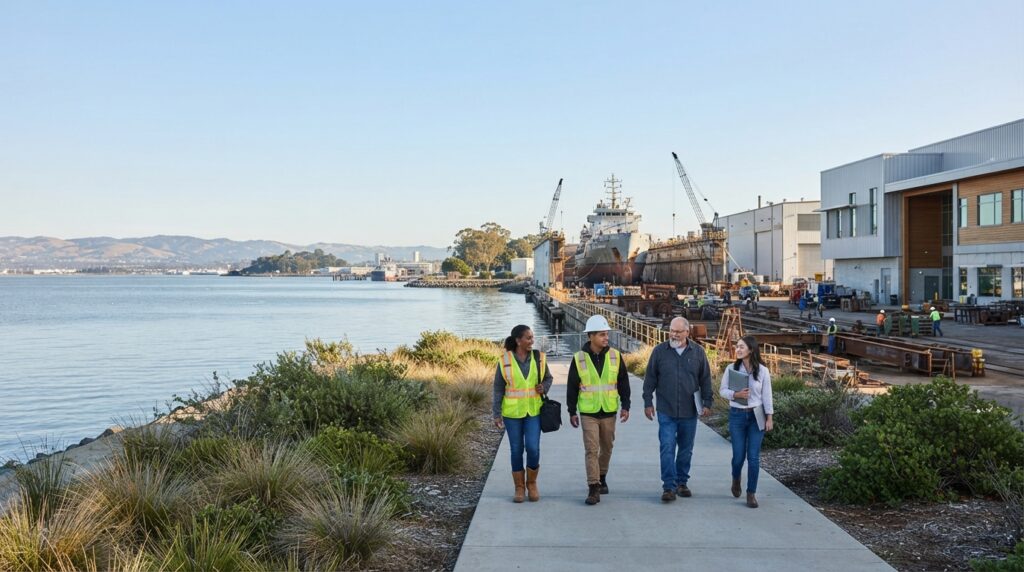
California’s economy is built from regional strengths. A shipyard, community college, research lab, manufacturer, port, and small business may serve different roles, but together they create a durable local economy. California Jobs First is designed to turn regional coordination into investment, workforce pathways, and long-term opportunity.
On August 26, 2026, California announced $48.5 million through the California Jobs First Regional Investment Initiative for 18 projects across eight economic regions and 33 counties. The state expects the awards to support 20,000 direct and indirect jobs. That figure is a projection, not a list of open positions, but it highlights industries California is positioning for growth.
What the new Jobs First awards fund

The latest awards are the final tranche of implementation funding through the Regional Investment Initiative. They build on years of planning in Jobs First regions, where local governments, employers, education partners, community organizations, and residents identified assets and economic priorities. Rather than applying one statewide formula, the program directs investment toward strategically important regional industries.
The state’s California Jobs First announcement describes seven project clusters across aerospace and defense, advanced manufacturing, high-tech, shipbuilding, space and satellites, and quantum. The awards aim to strengthen innovation, industry coordination, workforce development, supply chains, business attraction, and infrastructure.
A regional picture of California’s future economy
The $48.5 million total is spread across sector-based investments. Advanced manufacturing received the largest allocation at $17.75 million for Central San Joaquin innovation and supply chains and Capital Region biomanufacturing and workforce development. Shipbuilding received $8.236 million for the Bay Area Region, while quantum received $9.742 million for workforce development and regional coordination across Southern California.
Other funded clusters show the breadth of the strategy. The Southern Border Region received $3.95 million for aerospace and defense research and innovation infrastructure. The Inland SoCal Region received $1.94 million for high-tech infrastructure, workforce training, and business funding opportunities. Kern County received $6.846 million for business attraction and expansion connected to space, defense, and satellites.
Investment is not the same as a job opening
It is important to read these numbers accurately. The state expects the projects to support 20,000 direct and indirect jobs. This does not guarantee that 20,000 vacancies are available today, and the awards are not hiring announcements. Project owners must develop infrastructure, partnerships, education programs, and industry connections before many benefits can be measured.
That distinction makes the next phase important. Communities can watch for updates from regional collaboratives, colleges, employers, workforce-development organizations, and project leads. Students and workers should look for documented training, internships, apprenticeships, and employer-led opportunities rather than assume a grant award creates immediate employment.
Why maritime and manufacturing matter in the Bay Area
The Bay Area shipbuilding award offers an example of the regional approach. The state allocated $8.236 million to strengthen innovation, curriculum, workforce development, and coordination across the shipbuilding network. Within that award, Solano Economic Development Corporation received $2.42 million for the Bay Area Maritime Ecosystem Backbone Organization.
According to Solano EDC’s project announcement, the work is being developed with Cal Poly Maritime Academy and public, private, education, and economic-development partners across Solano, Contra Costa, and Alameda counties. Its goal is to improve coordination among industry, government, workforce, and education partners.
Three connected pieces of the maritime initiative
The initiative includes a Maritime Ecosystem Backbone Organization led by Solano EDC, a Maritime Innovation Campus led by Cal Poly Maritime Academy, and a Workforce Integration Network also led by the academy. These pieces connect planning, innovation and commercialization, and education-to-career pathways. An industry ecosystem needs more than a single facility or training course.
California’s ports already demonstrate how infrastructure and workforce needs can move together. Our article on port electrification and green job growth explains how cleaner port equipment can create demand for construction, manufacturing, engineering, and maintenance expertise. Maritime investment can complement that transition by strengthening the regional networks that connect employers, educators, and future workers.
Where workers and students can look for pathways
California Jobs First is most useful when regional investments become accessible pathways. Career and technical education programs, community colleges, universities, unions, employers, and workforce boards may each play a role. The first step depends on the region and sector, but a practical approach is to follow implementing organizations.
- Check local community colleges and career and technical education programs for manufacturing, maritime, engineering, logistics, or skilled-trades offerings.
- Follow regional California Jobs First collaboratives and awardees for verified events, training announcements, and project updates.
- Ask workforce-development boards about sector partnerships, apprenticeships, and supportive services that may accompany training.
- Monitor universities and employer partners for internships, work-based learning, research partnerships, and commercialization programs.
- Use official employer career pages for job openings rather than relying on projected statewide totals.
Workers may also find relevant opportunities where clean technology and maritime operations overlap. Our article on electric tugboats at California ports explores one example of an industry shift that can change the skills, equipment, and infrastructure a maritime workforce needs.
How to judge progress after the announcement
Announcements matter, but implementation determines whether regional investment delivers lasting public value. The key questions are whether it supports durable businesses, useful training, equitable access, and measurable regional capacity. Projects should report milestones, identify accountable partners, and communicate where residents can learn about opportunities.
California Jobs First grew from plans developed across all 13 regions. The state says they were formally recognized as Comprehensive Economic Development Strategies by the U.S. Economic Development Administration in 2025. That foundation can help regions coordinate future public, private, and philanthropic investment, but it does not remove the need for transparent local delivery.
The state’s broader economic resilience depends on this kind of follow-through. As explored in our article on California’s economic resilience amid global challenges, a diverse economy can adapt when it invests in people, infrastructure, innovation, and regional collaboration. The 2026 Jobs First awards create an opportunity to test that principle in specific industries and communities.
From regional strategy to real opportunity
The August 2026 awards do not promise instant jobs, but they identify where California is placing its next economic-development bets. Manufacturing, shipbuilding, aerospace, high-tech, space, and quantum sectors depend on coordinated education, infrastructure, research, supply chains, and business investment. The Initiative aims to strengthen those systems region by region.
For residents, the most useful response is to watch for concrete local pathways as implementation moves forward. For project leaders, the responsibility is to translate funding into accessible training, accountable partnerships, and measurable outcomes. When regional strategies are connected to real community participation and career access, California can build an economy that is not only innovative but also prepared to share opportunity more widely.