
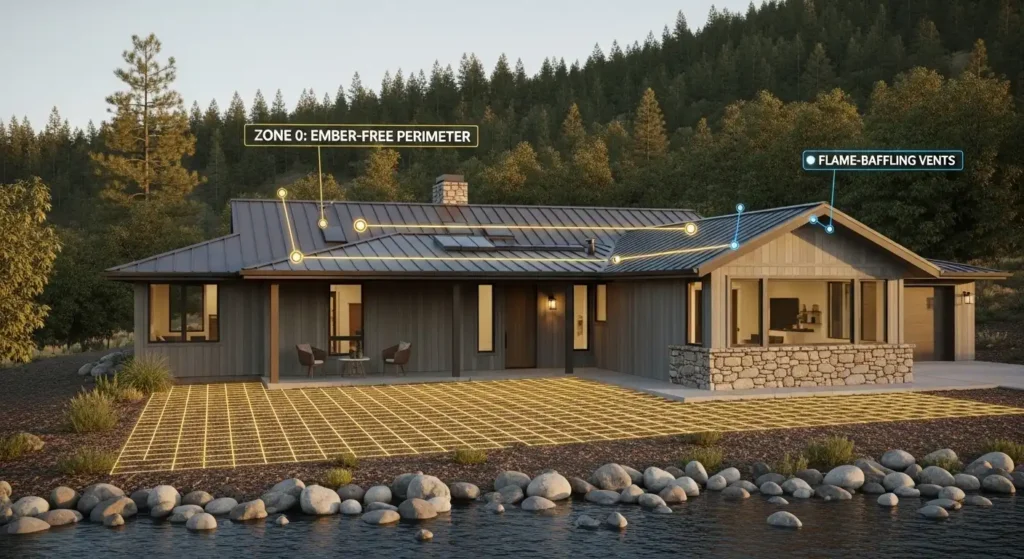
As we navigate the spring of 2026, the Golden State is reaching a critical inflection point in its battle against the increasing frequency and intensity of wildfires. For over a decade, “Defensible Space” was the primary mantra for homeowners—clearing brush, limbing trees, and maintaining a green lawn. However, as of April 2026, the California Home Hardening Initiative has officially shifted the focus from the landscape to the structure itself. In the insurance and real estate markets of 2026, a “clean yard” is no longer enough; your home must now be a hardened fortress against the threat of wind-driven embers.
The Science of Survival: Why 2026 Standards Matter
Extensive data from the 2024 and 2025 fire seasons in regions like Butte County and the Santa Cruz Mountains has fundamentally changed our understanding of home loss. We now know that nearly 90% of homes destroyed in wildfires are not ignited by a massive “wall of flame,” but rather by embers—tiny, wind-borne firebrands—that can travel miles ahead of the actual fire front. These embers find the “weak links” in a structure: an open eave, a pile of dry leaves in a gutter, or a combustible door mat.
The 2026 standards are designed to eliminate these weak links. By implementing “Structural Hardening,” homeowners are effectively sealing their homes against an ember blizzard. This proactive approach is what Its Good For California advocates for: a state where communities don’t just survive, but thrive through resilience.
The 0-5 Foot “Ember-Resistant” Zone: The New Mandate
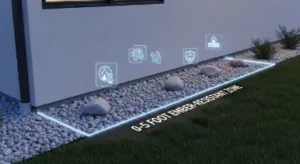 The most significant change in the April 2026 regulations is the enforcement of the “Zone 0” or the “Ember-Resistant Zone.” This is the first five feet extending out from the exterior of the building, including under any attached decks. In this zone, there can be zero combustible materials. This means no woody mulch, no wooden fences attached to the house, and no foundation plantings.
Homeowners are now transitioning these areas to non-combustible alternatives such as decomposed granite (DG), river rock, or decorative pavers. While this change is aesthetic, its function is vital: it prevents a ground fire from reaching the siding or burning through a crawlspace vent. This mandate is a key component of the current community assessments being conducted across the state this month. By creating a fuel-free moat around the home, we stop the fire’s path before it touches the structure.
Retrofitting for Resilience: Vents and Gutters
Beyond the ground level, the 2026 initiative focuses on the “envelope” of the house. Attic and crawlspace vents have historically been an “open door” for embers. Standard 1/4-inch mesh screens are no longer sufficient under the new code. Homeowners are now required (or highly incentivized by insurers) to install flame-baffling vents. These specialized vents contain materials that swell when exposed to high heat, effectively “choking out” the fire before it enters the home.
Gutters are the second major point of failure. Even if a roof is Class-A fire-rated, dry pine needles in a gutter can ignite and burn right into the roof’s edge. The 2026 standards prioritize non-combustible metal gutter guards that prevent debris accumulation while allowing water flow. These upgrades are not just about safety—they are about property value and long-term stewardship. A house with metal guards and boxed-in eaves is significantly more likely to remain standing after an ember storm than one with open rafters and plastic gutters.
The Insurance Connection: Protecting Your Assets
In 2026, the California Department of Insurance has authorized companies to offer significant premium discounts—and in some high-risk zones, guaranteed renewals—to homeowners who achieve “Hardened Home” certification. This is where the physical world meets your digital network of assets. For property managers and homeowners alike, maintaining a digital record of these upgrades is as important as the upgrades themselves.
Having a secure, verifiable record of your home hardening efforts is a critical part of your digital legacy and property records. In the event of a dispute with an insurer or a future property sale, these certificates serve as proof that the property meets the 2026 resilience standards. We recommend scanning all contractor invoices and inspection certificates into a secure, encrypted vault to ensure they are accessible after any local disaster.
Economic Resources: How to Fund Your Retrofit
We recognize that home hardening can be a significant financial undertaking. However, April 2026 has seen the expansion of the “California Wildfire Mitigation Program” (CWMP). This program offers grants of up to $40,000 for low-to-moderate-income households in designated “High Fire Hazard Severity Zones.” Furthermore, many local Butte County landmarks and community centers are acting as hubs for “Tool Lending Libraries,” allowing neighbors to share the equipment needed for clearing the 0-5 foot zone.
A Better Future for California Communities
 Home hardening is not just an individual task; it is a collective responsibility. When a house is hardened, it acts as a “buffer” for its neighbors. This reduces the overall “conflagration potential” of the entire neighborhood. This is exactly why these initiatives are good for California. By reducing the number of structures lost in a fire, we keep families in their homes, preserve our local tax bases, and prevent the ecological trauma associated with massive urban-interface fires. Community safety is built one house at a time.
Checklist: Are You Ready for 2026?
- Zone 0 Audit: Have you removed all mulch and woody plants within five feet of your foundation?
- Vent Check: Are your attic vents fitted with ember-resistant, flame-baffling screens?
- Gutter Maintenance: Are your gutters cleared and fitted with non-combustible metal guards?
- Digital Vault: Have you uploaded your “Home Hardening Certificate” to your secure property cloud?
- Eave Protection: Are your eaves enclosed (boxed-in) to prevent heat entrapment?
Conclusion
The April 2026 California Home Hardening standards represent a shift from a “reactionary” mindset to a “resilient” one. We are no longer just hoping the fire doesn’t come; we are ensuring that if it does, our homes are built to withstand it. By investing in structural hardening today, you are protecting the history, the community, and the future of our great state.
What steps have you taken to harden your home this spring? Let us know in the comments below, or reach out for a list of local Butte County contractors specializing in these 2026 retrofits! Together, we can build a California that is as safe as it is beautiful.